
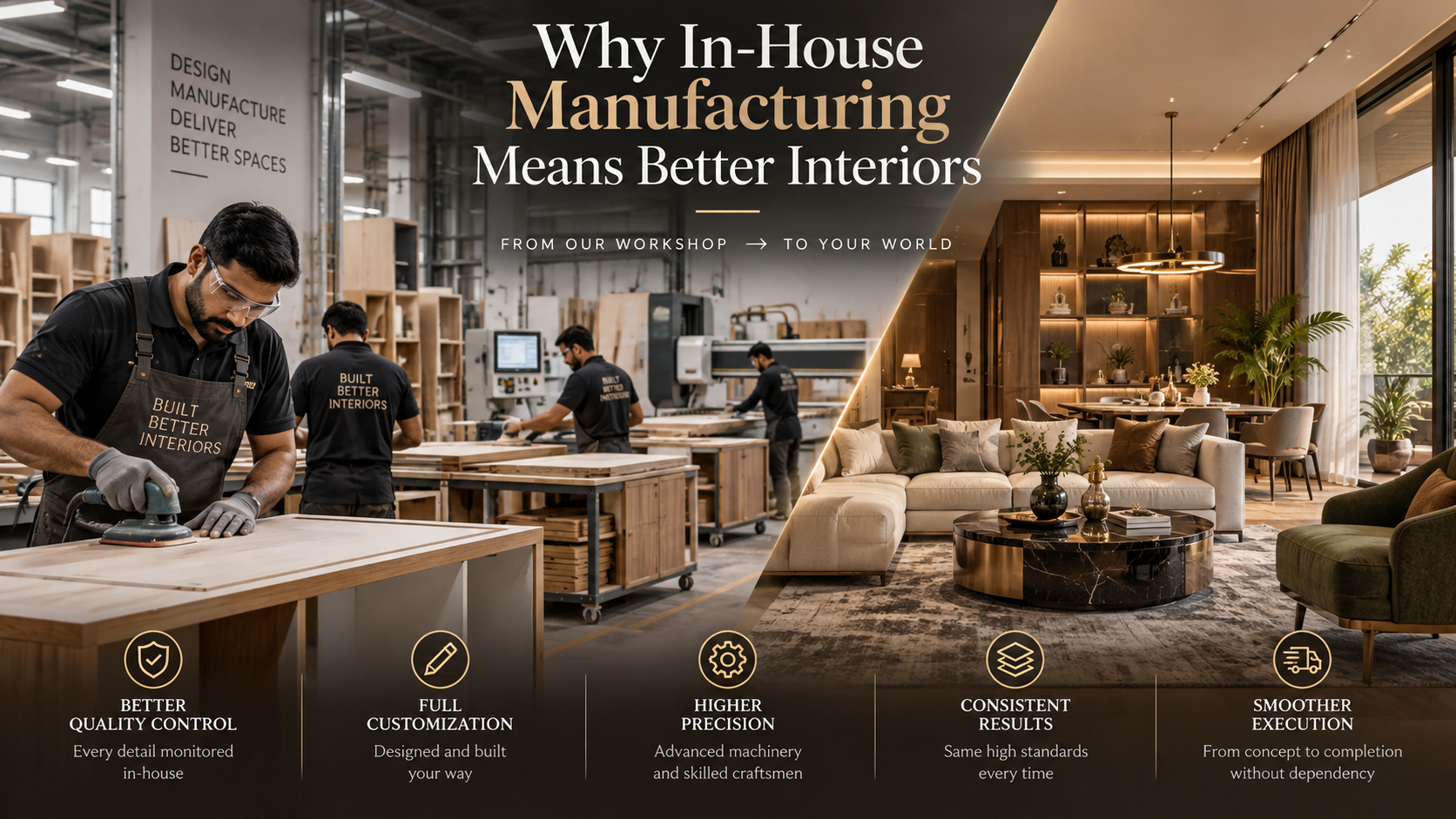
Why In-House Manufacturing Means Better Interiors
How most interior projects actually get built
In a typical project, the interior firm handles design and site supervision. The actual making is farmed out. A carpenter's workshop builds the furniture. A separate fabricator does the metal work. Someone else handles the glass, and another vendor does the MS structures.
On paper, that works. In practice, every handover is a place where things go wrong:
- Drawings get reinterpreted. Each vendor reads the design through their own tools and habits. Small deviations add up across dozens of pieces.
- Quality depends on whoever is free. Your project competes for workshop time with every other client that vendor has.
- Delays cascade. If the metal frame is late, the woodwork that sits on it waits, and so does the finishing team.
- Nobody owns the whole result. When a joint doesn't line up, the carpenter blames the fabricator, and the fabricator blames the site measurements.
The client ends up absorbing the cost of all that friction, in time, money and compromise.
Inside Shomli's three manufacturing units
Our factory is the backbone of Shomli Interiors. It runs as three dedicated units, each built around a different material:
|
Unit |
What it makes |
Key technology |
|---|---|---|
|
Unit 1: Wood Factory |
Furniture, cabinetry, wall panelling, display units, reception desks |
CNC machines, beam saw |
|
Unit 2: Metal Factory |
Decorative metal work, frames, trims, detailed fixtures |
Modern cutting and shaping, laser cutting |
|
Unit 3: MS Factory |
Heavy structures and custom MS fabrication |
Fabrication machinery with skilled welders |
Between the three, almost every physical element of a commercial interior can be made under one roof. That means raw timber and steel come in, and finished, site-ready pieces go out.
Machines give us precision. But the craft still comes from people. Our carpenters, fabricators and finishers work on Shomli projects every day, not just when a vendor has a free slot.
Five ways in-house manufacturing makes your interior better
1. What you approve is what you get
Our designers work in AutoCAD, SketchUp, Enscape and V-Ray. Those same drawings go straight to our own production floor. CNC and laser cutting follow the drawing exactly, so the reception desk in your render is the reception desk on your site. No reinterpretation by an outside workshop.
2. Quality is checked at every stage, not just at handover
When you outsource, you usually see the quality only when the piece arrives on site. By then, fixing it costs time. In our own factory, our team checks material, joinery and finish as each piece is made. Problems are caught before anything leaves the floor.
3. Timelines you can actually plan around
We control our own production schedule. Wood, metal and MS work can run in parallel, and we can prioritise a project when a launch date is fixed. For a retail brand opening a showroom or a hospital commissioning a new wing, that predictability matters as much as the design itself.
4. More design freedom
Custom shapes, curved panels, intricate metal screens and combined wood-and-metal pieces are hard to get right across multiple vendors. With all three materials made in-house, our designers can propose details that would be risky to outsource, and our factory can build them.
5. One team, one point of accountability
From BOQ to drawings, manufacturing, installation and snag work, it's the same company. If something needs fixing, there's one number to call and no finger-pointing between contractors. That's what turnkey should really mean.
Where it makes the biggest difference
In-house manufacturing helps every project, but some kinds of spaces depend on it:
- Jewellery showrooms. Display counters, lighting coves and security-conscious fixtures need millimetre precision and premium finishes. It's why brands like Thangamayil, Bhima Jewellery and Pothys Swarna Mahal trust us with their stores.
- Retail chains. When a brand rolls out many stores, every outlet must look identical. Making fixtures in one factory keeps them consistent. Our work with Poorvika, including their 75,000 sq ft Chennai facility, is built on that.
- Hospitals and healthcare. Fixed commissioning dates and hygienic, durable materials leave little room for vendor delays. We've delivered for Kauvery, Care Vale and Vedanayagam Hospital.
- Colleges and universities. Large volumes of classroom, lab and hostel furniture need to be made to one standard, on an academic calendar. Projects like Sai University and Mailam show how that scales.
- Corporate offices. Workstations, cabins, glass partitions and pantries all come from one source, so the space feels like one design, not a patchwork.
Before you hire an interior firm, ask these questions
Whoever you choose, these questions will tell you a lot about how your project will really be delivered:
- Do you manufacture furniture and fixtures yourselves, or through vendors?
- Can I visit your factory and see work in progress?
- Who is responsible if a fabricated piece doesn't match the approved drawing?
- How do you check quality before items reach the site?
- What happens to my timeline if one of your suppliers is delayed?
A firm that makes what it designs will answer these easily. A firm that doesn't will have to rely on someone else's promise.